[SMM Blast Furnace Operating Rate] As Steel Mill Profits Shrank, Pig Iron Production Slightly Declined

Published: Nov 7, 2024 10:59
Source: SMM
According to an SMM survey, on November 6, the operating rate of blast furnaces at 242 steel mills surveyed by SMM was 90.60%, flat WoW.

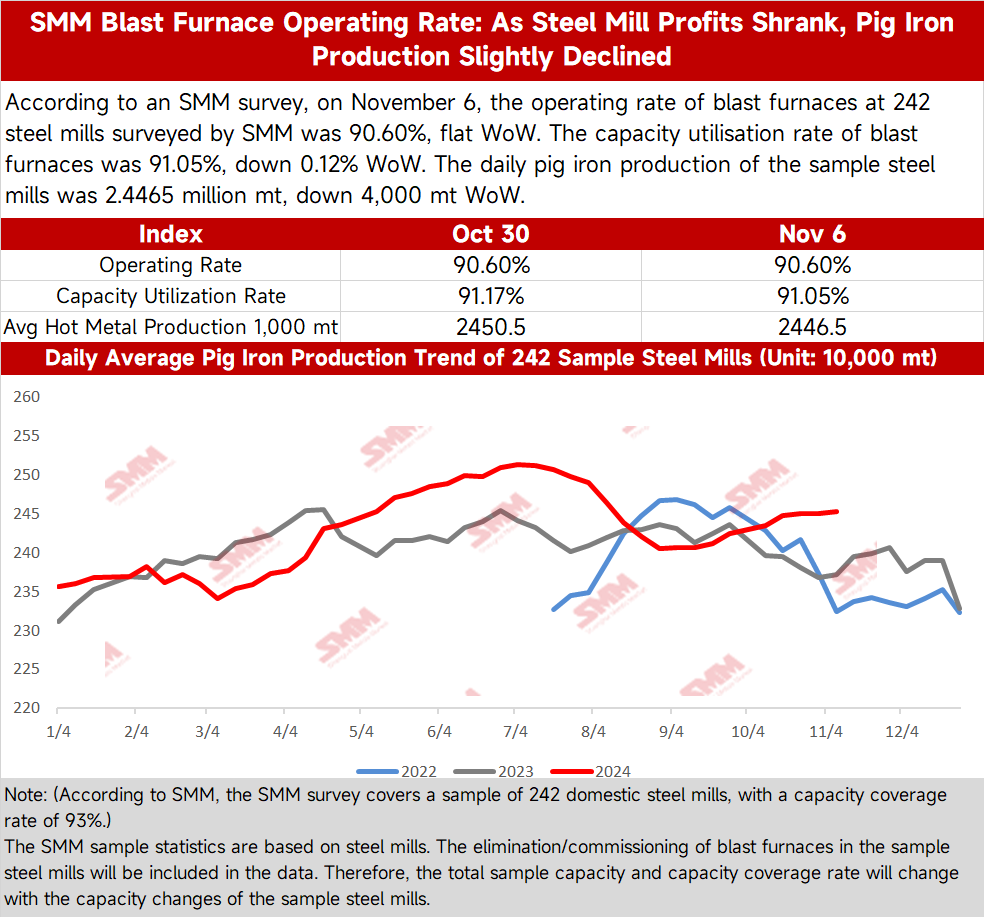
According to an SMM survey, on November 6, the operating rate of blast furnaces at 242 steel mills surveyed by SMM was 90.60%, flat WoW. The capacity utilisation rate of blast furnaces was 91.05%, down 0.12% WoW. The daily pig iron production of the sample steel mills was 2.4465 million mt, down 4,000 mt WoW.

Image 1: Blast Furnace Operating Rate & Capacity Utilisation Rate
Data Source: SMM

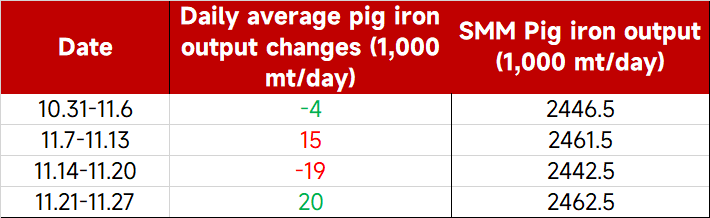
Image 2: Future Pig Iron Forecast
Data Source: SMM

During this period, two blast furnaces underwent maintenance, and another two blast furnaces resumed production. As the year-end approaches, the routine annual maintenance of some blast furnaces, combined with the recent decline in steel mill profits, has led to the lower-than-expected resumption of blast furnaces at some steel mills, resulting in a slight decline in overall pig iron production.

According to the latest tracking by SMM, some steel mills still plan to resume blast furnace production on schedule next week, and pig iron production may rise again. However, considering the recent mediocre steel demand and the gradually decreasing temperatures, some steel mills in north-west China may have new winter shutdown plans, and the growth in pig iron production may be lower than expected.

190 Sample Blast Furnace Operating Rate
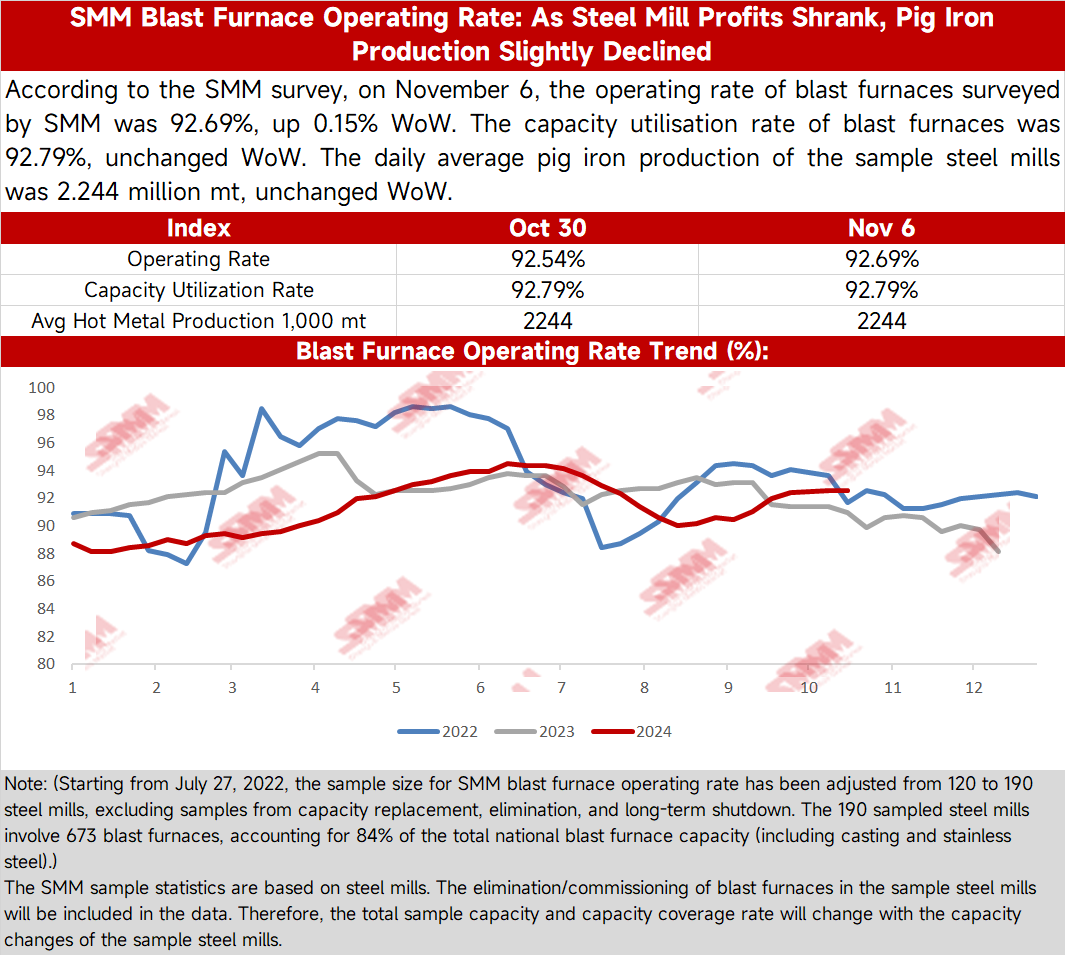
Data Source Statement: Except for publicly available information, all other data are processed by SMM based on publicly available information, market communication, and relying on SMM‘s internal database model. They are for reference only and do not constitute decision-making recommendations.

For any inquiries or to learn more information, please contact: lemonzhao@smm.cn
For more information on how to access our research reports, please contact:service.en@smm.cn
Related News
[SMM Steel] Tata Steel to merge NINL; plans $2 billion investment in Singapore subsidiary
8 hours ago
[SMM Steel] Tata Steel to merge NINL; plans $2 billion investment in Singapore subsidiary
Read More
[SMM Steel] Tata Steel to merge NINL; plans $2 billion investment in Singapore subsidiary
[SMM Steel] Tata Steel to merge NINL; plans $2 billion investment in Singapore subsidiary
[SMM Steel] Tata Steel Limited announced on March 18, 2026, the merger of its wholly-owned subsidiary, Nilachal Ispat Nigam Limited (NINL), to consolidate its long products business. The merger aims to enhance management efficiency and accelerate capacity expansion at the Odisha mill from 0.98 million mt to 4.8 million mt. Additionally, the board approved a $2 billion investment in its Singapore-based subsidiary, T Steel Holdings Pte Ltd (TSHP), starting in FY 2026-27 to support overseas operations, fund capex, and restructure existing debts.
8 hours ago
MMi Daily Iron Ore Report (March 18)
9 hours ago
MMi Daily Iron Ore Report (March 18)
Read More
MMi Daily Iron Ore Report (March 18)
Today, DCE iron ore futures were in the doldrums today. The most-traded contract, I2605, finally closed at 811 yuan/mt, down 0.12% from the previous trading session. Spot prices fell by about 2-5 yuan from the previous trading day.
9 hours ago
[Brief Review of China’s Iron Ore Market] Resource Supply in West Liaoning Was Tight, and Local Ore Prices Might Rise Slightly
10 hours ago
[Brief Review of China’s Iron Ore Market] Resource Supply in West Liaoning Was Tight, and Local Ore Prices Might Rise Slightly
Read More
[Brief Review of China’s Iron Ore Market] Resource Supply in West Liaoning Was Tight, and Local Ore Prices Might Rise Slightly
[Brief Review of China’s Iron Ore Market] Resource Supply in West Liaoning Was Tight, and Local Ore Prices Might Rise Slightly
[China Iron Ore Brief Review: Tight Resources in West Liaoning, Local Ore Prices May Edge Up Slightly] The domestic ore market in west Liaoning was relatively stable, with the ex-factory prices of 66-grade iron ore concentrates, wet basis and excluding tax, at 730-740 yuan/mt. Supply and demand were clearly in a wait-and-see mode. Beneficiation plants, considering the relatively small inventory pressure, temporarily held back from selling. Against this backdrop, traders were not highly motivated to make inquiries, and only a few made price inquiries based on their own needs. Affected by safety and environmental protection inspections, mining was restricted, and a small number of operating beneficiation plants suspended production for maintenance due to constraints in ROM resources. Circulating spot resources remained tight, which still provided certain support for ore prices.
10 hours ago